Friday, October 2, 2015

Narbonne

Narbonne Market
Next time you head to a large market, take your chef with you! Alexandre was a treasure trove of information for everything we saw – and tasted. They shop there for the barge trips weekly, so he knows the people we were talking to (well…they were talking and interpreting for us). We tasted olives, tapenades, cheeses, breads, and learned about the abundance meats (well, they did anyway). There are quite a few fruits and veggies that I had never seen before – and Alex bought a bit of all of them and incorporated them into our meals for the next few days. Black radishes, Lulo frute (Naranjilla) and the tamarillo – delicious! It was great fun to try new things – now to see if they’re available anywhere back home – Portland most likely.
Old city from the canal


Cathedral from the top
We walked (above) the old Roman Road that traveled through the metropolitan city of Narbonne. At one time it was an important trading post and port city but over the years the port filled in and it is now 15 km or so from the sea. The Archbishop’s palace, a large Gothic structure, houses a number of interesting museums…as well as the entrance to the tower. We, of course, had to climb to the top for a fabulous view of a cathedral and the town of Narbonne. Sadly there was little time to explore the city because it was already lunch time. We were treated to lunch at a local restaurant. Even though Alex wasn’t our chef today, he still made sure that the restaurant knew about our needs and they prepared a wonderful meal (though not as good as Alex’s if I do say so).

Carcassone


The next day found us back on the water, floating, and biking, along more scenic waterways until it was time to head out for the Lagasse Abbey, one of the largest abbeys in France that dates back to the 8th century. The abbey has now been divided; the medieval, older part of the abbey is open to the public while the more 18th century renovations is part of a religious community. While portions are still under renovations, we were able to visit much of the chapel and living areas of the original abbey. No day is complete without a winery visit, this time in the Villemagne.


Our final day dropped us into the City of Carcassonne from the 12th century. The fortress created on the site was formidable with a fortified chateau (residential buildings) and a number of protective measure taken to keep foreign invaders out, should they get past the double outer walls – a necessary precaution with the Crusades going on. The outer walls have been restored and portions of the ramparts are open for walking along, with, of course, spectacular views of the city and surrounding country-side.

Saturday, April 4, 2015

Crete Botanical Park

Crete boasts a Botanical Garden, perched at the foot of White Mountain, overlooking a river and a broad valley, this 50 acre garden is a treasure – and we were there before everything was even in bloom. I can only imagine what it’s like in the middle of the summer!
Bird of Paradise
Check out the bee
The people here are so generous – the park wasn’t even open yet  - winter storms had left so much of it requiring clean up. The owners, however, let us, and numerous other tourists, roam the tranquil paths, finding tiny delightful flowers pushing their way through the strewn leaves. We honestly found plants we’d never seen before and a great chance to take undisturbed pictures, or just sit and enjoy the peace.

Being located in a Mediterranean climate, the number of plants that can survive in the climate is amazing The path wound down through various regions with a fruit trees garden, herbs – medical and culinary with information, tropical garden, vineyards, and a variety of cherry trees!


Picturesque peacock

At the bottom of the hill, we found a small animal refuge with numerous birds roaming around a small pond. The turkey was interested in us, following us and preening his feathers. I think he was angling for attention – after all, he was competing with the peacocks. Across the meadow you could see a huge number of bee boxes – we had noted many of them placed along the path - with the bees merrily pollinating.  Jeff got a couple of spectacular shots of the bees in action - check out his Facebook.
There was one more unique plant we found...this one in a restaurant. While it has the looks of a cactus, further searching online has identified it as "Frilled Fan" and a member of a completely different family of plants. Had never seen anything like it.


Roaming through Crete

Chrysoskalitissa
Doorway view
We headed out further west the next morning, driving through tiny villages perched on the mountainside. Some villages seem to be no more than a dozen houses. Besides farming in the area, you have to wonder what they do for a living. The commute would be horrific!


Well kept, very large monastery
We headed out to explore, stopping at various picturesque places along the way. The Monastery of 

Chrysoskalitissa was intriguing…but closed. We did get to wander around a bit but didn’t have the chance to explore the museum and interior. There are many monasteries on Crete and we had a chance to explore a couple of them. Generally we could take outside pictures but not any inside. Most of them were extremely old, with few priests or monks as caretakers. Have to wonder how long so many of them have been in existence. The history must be amazing.


We finally reached the famous beach, Elafanisis. The water is a crystal clear turquoise, stunning in contrast to the rich blue of the ocean. There is a sand spit you can walk along at low tide...at high tide you'd be slogging though knee high water, connecting the two pools of water. In the summer high season, the beach is full of people...we had it to ourselves! The view, the colors, the privacy! The drive was spectacular, weaving through country roads, and very tiny towns going out and then traveling along the high mountain cliffs bordering the eastern side of the island – at times the cliffs dropped directly into the sea!


Roaming through old town is delightful - though parts of it are quite touristy. Did have some places with gorgeous hand made items and beautiful ceramic and wood products. Not too many people roaming now since its out of season. Friday made up for it at least as far as the bars and restaurants were concerned. There's a college near here and the pace was mobbed with young people everywhere. Tonight you can tell they've headed back for school...the place was very quiet and filled with lots of older people instead.

The restaurants were fantastic! Our host in the hotel suggested a number of places to try out. She avoided the obvious touristy places, sending us to back streets and small places - wonderful food! Obviously she is a person with a keen taste for fabulous food because every place was worth returning to. The only problem we had was that the food was served family style...fine once we found out but the first night! Aye aye aye! We ordered way too much food. Finally got it down to a very manageable, delightful repast.

Crete

Crete. Land of green, winding roads, blue skies, most of the time, and beautiful coastlines. What a treat.
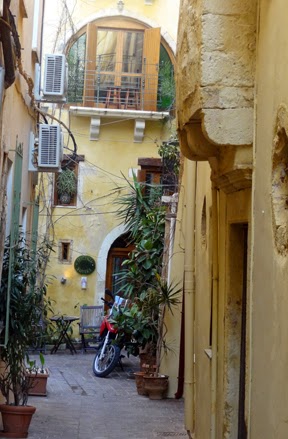
I called it quits here!
We had a leisurely drive from Heraklion to the city of Chania, second larges city and one - time capital of Crete. The country sports many wide, modern roads as well as the typical narrower highways that wind through the mountains and coastal areas. However, traveling through the city streets was not quite the same. We were, quite literally back to Japan, with tiny winding streets meandering between buildings set right on the streets, frequently without a sidewalk I between. Unlike Japan, the drivers are impatient, expecting you to drive on the shoulder so they can pass. Our navie system is usually up to the minute with information but I'm afraid not so here. She took us through a series of one-way streets...the wrong way a couple of times before I started being much more critical of what she was telling us to do! We spent a long time trying to find out hotel...I finally stopped in the middle of the road, rather a footpath if you really want to name it correctly, and waited while Jeff searched it out.
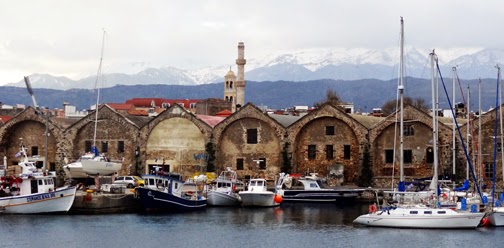
Original boathouses with snowcapped mountains!
The Casa Delfino is a delightful hotel, set in the middle of old town; a collection of (touristy) shops with lots of things available to buy to remember your trip. Better, though, is the history story woven around the old buildings. The buildings are primarily built with stone, a very common building material here. They're faced with stucco type materials, or concrete now, and painted with a wash of different colors. The island has been invaded by numerous groups, from Minoans to Venetians as well as Germans (and quite a few others), so the influence of the different cultures shows through.
 

The lighthouse at the end of the breakwater is probably the most photographed, iconic symbol of the city. You can walk along the breakwater out to it, finding a gorgeous view of the town; perfect just as the sun is setting - a striking picture with the snow covered mountains behind.